|
|
- HOME
- Archive for Love Hina.
I have heard good things about Love Hina for years. The buzz for both the manga and the anime was uniformly good enough that I kept it on the radar and made an effort to avoid spoilers. Now that I've finally seen the anime, I am happy to say that as much as Serial Experiments Lain disappointed me earlier, the brilliance of Love Hina exceeded my wildest expectations.
(more…)
Posted in Love Hina | Tags: Asakawa Yuu, DVDs and Blu-ray discs, Fan Service, Harem Comedy, Megumi Hayashibara, Movies and OVAs, Spring 2000, Summer 2000, tsundere, Yui Horie | Permanent Link
I made a simple Love Hina Winamp skin featuring Narusegawa Naru.
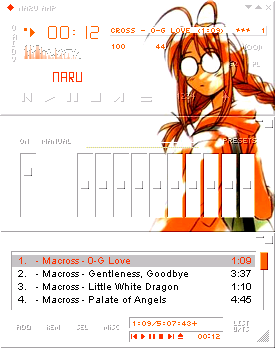
Love Hina Winamp skin
This is my first skin and I've only tested it on Winamp 2.80, so results may vary. I also made it so the volume button disappears when it's at 100%. I didn't bother skinning the mini-browser because I never use it.
Posted in Love Hina | Tags: Computers | Permanent Link
There is a moment in Chapter 54 of the Love Hina manga that perfectly exemplifies the two main themes that ensured the series' success: Emotional resonance punctuated with giant robots.
You see, a romantic is not someone obsessed with affection and happiness. A romantic is someone who in the absence of affection and happiness retains a (usually unjustifiable) confidence in hope.
Love Hina is richly steeped in romance. However, from a creative perspective, romance alone is not enough. Giant robots—the absurd, the unexpected—are also occasionally needed in the calculus. It's the yin-yang thing at work, y'know.
The presence of the former without the latter can cause an otherwise sweet story to become saccharine. Likewise, the presence of the latter without the former will often prevent an audience from developing an emotional commitment strong enough to care about the characters or the direction of the narrative.
This is hardly an original idea. Fans of Buffy the Vampire Slayer will recognize this theorem from a similar statement made by Joss Whedon on the Season Two DVDs. (I am substituting "giant robots" for Whedon's "rocket launchers," but the reasoning is unchanged.)
I am mentioning all of this for two reasons. First, with the new fall television season upon us, I think you'll notice that the success or failure of any given show will depend heavily on how it balances these two thematic elements. Although it is a fairly trivial matter to predict a new show's future by measuring the amount of pure, unadulterated suck it delivers through one's television set, nevertheless, it may be interesting to evaluate the shortcomings objectively. Second, I just wanted to say in a roundabout, excessively verbose, indirect way that the Love Hina manga is like the best thing ever—even better than the anime. Rest assured that despite being 14 books long, it doesn't have nearly as much filler as I've posted here today.
Be sure to tune in next time when I post my 29,000-word thesis on why Asuka wears her plug suit's hair clips all the time. (Short answer: Asuka interprets her own personal worth solely through her identity as an Eva pilot. Bonus answer: Similarly, Shinji uses his SDAT player to physically manifest what Ritsuko calls his "hedgehog's dilemma.") And there will be more fan service, too!
Posted in Love Hina, Love Hina (manga) | Tags: Harem Comedy, Manga, Romance, tsundere | Permanent Link
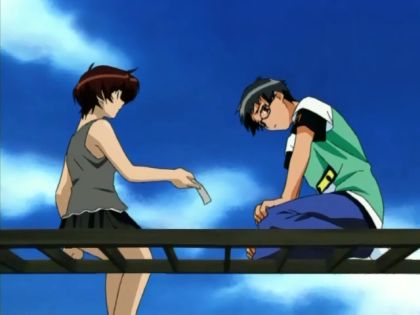
Kasumi and Kazuya.
I have come to the conclusion that the ladder in Hand Maid May is superior to the, uh, hole in Love Hina. That is all.
Posted in GIRL NEXT DOOR, Hand Maid May, Love Hina | Tags: Androids, GIRL NEXT DOOR, Harem Comedy, Maids, Re-Watching, Summer 2000 | Permanent Link
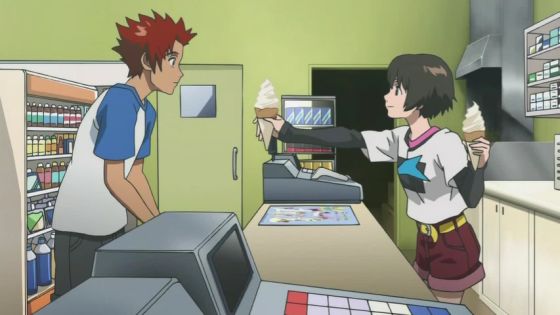
Kaminagi is a Girl Next Door because her apartment
building is only an apple's throw away, okay?
Among the many moe stereotypes, you'll frequently find the Childhood Friend. She is a staple of harem comedies and pretty much anything related to dating sims or eroge. One study suggests that the Childhood Friend does quite well for herself, even if she does not necessarily have the inside track.
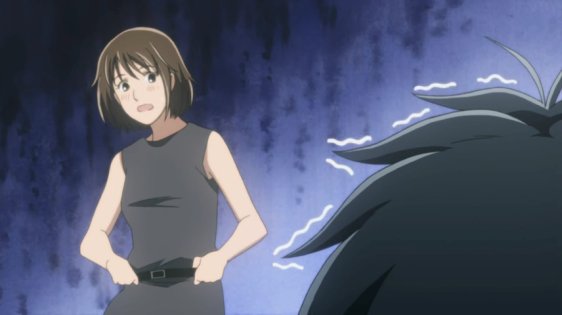
Sometimes you're taking your chances with the Girl Next Door.
In addition to the Childhood Friend, you'll also find the Clumsy Girl, the Class Rep, the Athletic Girl, and the Shrine Maiden, among others. Curiously, you won't find the Girl Next Door quite as often.
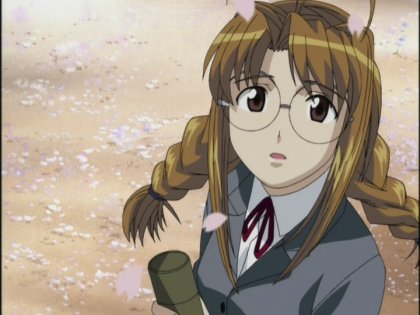
Calling Naru a Girl Next Door might be a stretch,
but the floor/ceiling hole convinces me.
Perhaps the Girl Next Door is a convention foreign to Japan, at least compared to her stature in American culture. You'll remember that Hugh Hefner built his empire on her charms. He explicitly states that his Playboy centerfolds represent the Girl Next Door. (I would argue that the typical centerfold has looked less and less like "the girl next door" over the years, but you get the idea.)
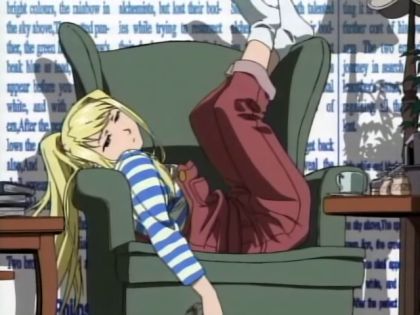
A Childhood Friend, Winry is also a Girl Next Door,
even if her house is kinda far. They live in sugei inaka.
But where ranks the Girl Next Door among anime cliches? When she does appear, she's sometimes also the Childhood Friend or some other more common cliche. It's like she's just the Girl Next Door by happenstance.
Kasumi might be the best Girl Next Door in all anime.
So, while I can't claim the Girl Next Door is rare, she is uncommon where anime is concerned—uncommon and under-appreciated. All glory to the Girl Next Door. When you're with her, it feels like home.
Posted in E/N, Fullmetal Alchemist, GIRL NEXT DOOR, Hand Maid May, Love Hina, Nodame Cantabile, Zegapain | Tags: GIRL NEXT DOOR | Permanent Link
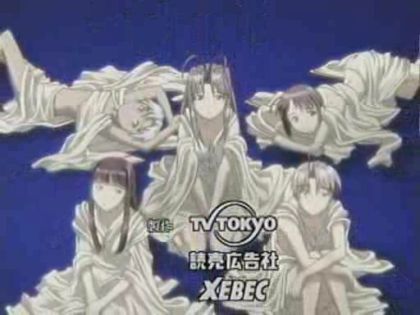
This was considered pretty good quality at the time.
All right, here goes: I never skip the opening and closing credits of any episode of anime I watch. That's right, I watch every single OP and ED of every single episode, even for episodes I've already seen before. The only time I skip an OP or ED is when the encode does not include them (as with many of these old ass Love Hina first-generation digisubs that I am sort of re-watching right now).

I admit dancing in the rain helped Shimizu win Best Girl of the Year.
Nearly every single time I've made the admission, the response has been incredulous. Yes, I know it's a very simple matter to set up a hotkey that jumps the video ahead 90 seconds (plus, better containers and, you know, actual store-bought discs permit you to chapter skip), but I don't watch every OP and ED because I'm too lazy or ignorant to skip them. I watch them every time because I consider them part of the show.
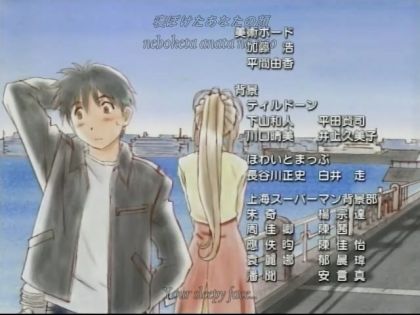
All right, I haven't bought the Ah! My Goddess series DVDs yet, okay?
At least I've purchased The Adventures of Mini-Goddess,
the OVA, the movie, and the manga already.
And since I consider OPs and EDs part of the show, how much I like or dislike an OP or ED affects how much I like the show as a whole. Disliking the Lucky Star OP is one of the reasons I've never finished watching the series. I do find Lucky Star a little boring (and I straight-up dislike Lucky Channel), but I probably would have finished watching it by now if I really liked the OP instead. Likewise, I am grateful the Macademi Wasshoi OP is horrible, because it guaranteed I would find the series not just terrible, but completely unwatchable after the first episode.

I like First Winry better even though she doesn't
have massive hips or manhands.
However, since I consider OPs and EDs "part of the show," does this mean I consider OPs and EDs canon? Well, no, although I suspect there are times we would all like to think of scenes depicted within OPs and EDs as canonical. For example, Shimizu dancing in the rain during Major season four, or the Winry's-daily-life EDs from either of the Fullmetal Alchemist series. These sequences are reasonably plausibly canon—as much so as the Aa! Megami-sama TV "date" ED which we know from the manga is canon.
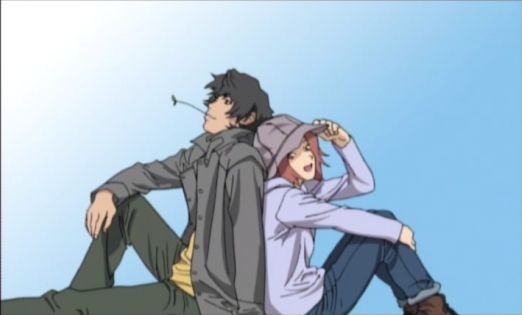
A bodyguard and his poor little rich girl.
What about ones like the Kaze no Yojimbo OP? Depending on your point of view, it might be nice to think those events actually happened, and from a certain perspective I can see how it's at least plausible, but I think it's more likely the scenes are pure misdirection—perhaps to divert some attention from what the show is really about. Not that OPs and EDs can't include misdirection and still be canon. Princess Tutu, I'm looking in your direction....
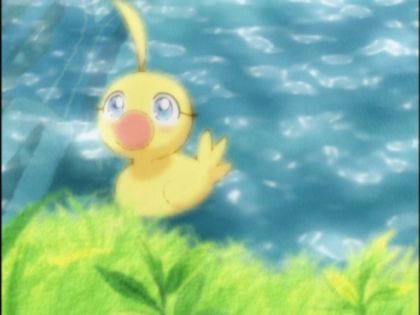
Ahiru as a duck. Unless you're ADV,
in which case it's Duck as a duck.
So what is worse? That I never skip OPs and EDs or that I care about them? Surely it's not that strange, is it? On days like these, I'm probably lucky I leave comments disabled.
Posted in Aa! Megami-sama, E/N, Fullmetal Alchemist, Fullmetal Alchemist: Brotherhood, Kaze no Yojimbo, Love Hina, Macademi Wasshoi!, Major, Princess Tutu | Tags: baseball, Childhood Friend, Comments Disabled, GIRL NEXT DOOR, Mahou Shoujo, OP ED, Poor Little Rich Girls, Spoilers | Permanent Link
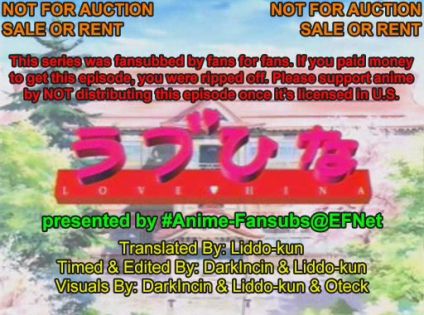
At least there's no spinning watermark.
Although I own all the DVDs, I chose to re-watch my archive of Love Hina fansubs over the past few months. As you might expect, the video and audio quality is atrocious by modern standards, with 320x240 15fps encodes being the norm. (The entire season fits on two CD-Rs.) Depending on the group, the subtitles themselves can also be quite poor by today's standards. Many lines are poorly timed and some episodes were clearly finished by non-native English speakers. Every single episode was generally inferior from a technical perspective than the samples in my recent Chu-Bra!! PSP experiment. Nevertheless, Love Hina in this crude form invokes a certain nostalgia when remembering the brief, recent history of anime distribution in America.
Try a little tenderness, Keitaro.
Love Hina was one of the first shows successfully distributed widely in entirely digital formats. Although the initial rips came from analog broadcasts, the Internet (and sneakernet) distribution of Love Hina episodes was accomplished digitally. Heretofore, American anime fans typically purchased, traded, or copied videotapes of fansubs. This is how I first watched All Purpose Cultural Cat Girl Nuku Nuku, for example. For those unfamiliar with the medium, videotapes are purely analog, so the quality degrades significantly after each generation. If you were lucky, you got to watch something that was low enough on the copy-of-a-copy-of-a-copy chain that it did not look like mush.

Aneue > Onee-sama.
What a long way we've come in merely a decade. Fansubs today appear with soft-subs that can be turned off and video quality that surpasses DVD limitations by a large margin. No wonder the anime DVD bubble collapsed so quickly. I, like many buyers, contracted my buying habits once DVDs became clearly inferior to recordings of initial broadcasts—waiting for Blu-ray releases. I'm still waiting. FUNimation is taking cautious steps, but I won't be cajoled long by lackluster upscales.
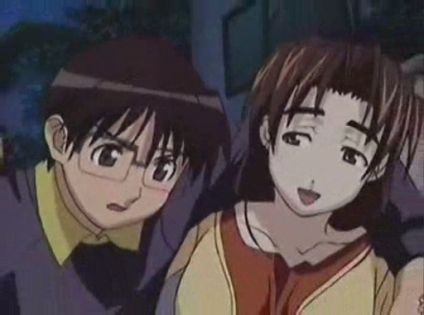
Keitaro's dilemma at the end of Love Hina is not
unlike Shinji's struggle with Instrumentality.
So what about Love Hina itself? Many former fans have recanted their affection for the title, disclaiming, "I hadn't seen much anime at that time, so I didn't know better." I still find Love Hina as charming and funny as ever. It balances a winning combination of absurd mechanized turtles and emotional resonance. It's a relic from a time of the big-boobed tsundere (before the stereotype turned into a complete joke), to be sure, and its harem comedy roots were unoriginal even then, but its cast remains engaging. Megumi Hayashibara is still absolutely dead-on as Aunt Haruka, and a round or two with Motoko reminds me how sorely Asakawa Yuu is missed. Likewise, the motif about promises still rings true today; it carries more import than the typical canned motivations anime characters generally spout. And perhaps it also implores viewers to remember a past they once loved and should not forget.
Posted in Loot, Love Hina | Tags: Harem Comedy, Hime Cut, History, Megumi Hayashibara, PSP Experiment, Try a Little Tenderness, tsundere, Yui Horie | Permanent Link
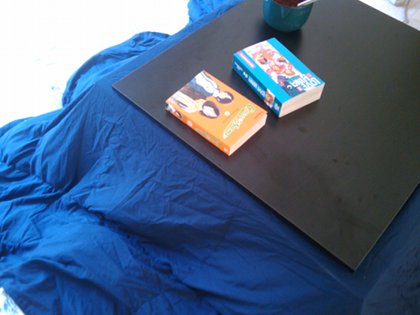
Behold, the bespoke kotatsu, in all its glory.
Okay, I didn't really build a kotatsu. I bolted an electric wall-mountable low-wattage ceramic heater to the underside of a cheap square coffee table.
My first encounter with a kotatsu was almost 10 years ago, while watching Love Hina. There's an early scene during which Keitaro is forced to hide underneath one for some contrived reason. At the time, I couldn't understand why he was complaining about the heat. Reading the manga (incidentally, offered online for free by its author, Ken Akamatsu) clarified things a bit. 14 volumes of Love Hina gave me a better understanding as to the functions and features of this weirdo heated table thing. Still, I couldn't understand why Keitaro wasn't bending Naru over the kotatsu at every opportunity, but that question is not germane at this time.
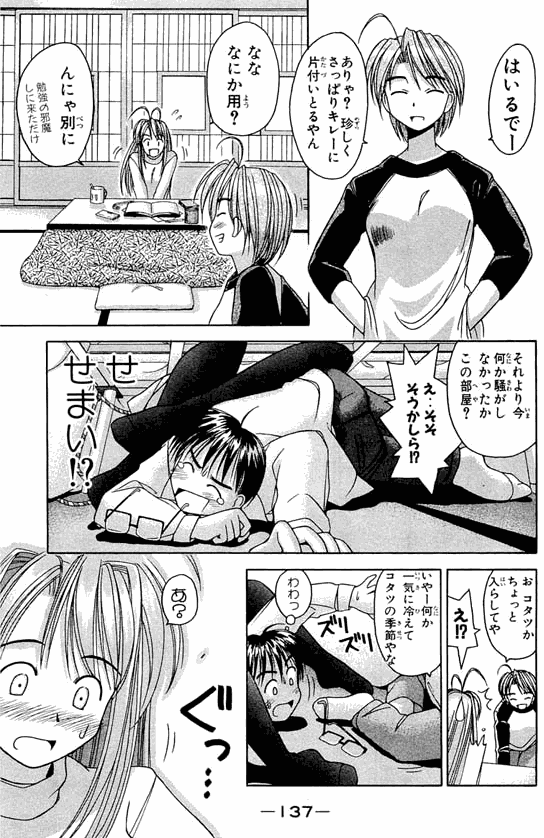
Naru's kotatsu is big enough for two. Three, if you're perverts.
There are probably a few changes I would incorporate were I to construct Ghetto Kotatsu 2.0, pending further testing. It doesn't help at all that the temperature in Southern California was regularly in the 80s this January (think high 20s, if you use Celcius).
Posted in Loot, Love Hina, Love Hina (manga) | Tags: All-Time Babes, Bend Her Over a Kotatsu, Building Stuff, Harem Comedy, Ken Akamatsu | Permanent Link
|
|